Iron Nanoparticles: Synthesis Strategies, Properties and Multidisciplinary Applications
Dipak Sonawane
Sanjivani University, Kopargaon, Maharashtra, India.
Nachiketa Sahu
Sanjivani University, Kopargaon, Maharashtra, India.
Ashwini Kanade
Sandip University, Nashik, Maharashtra, India.
Naziya M.A. Rehman *
Dr.BAMU, Chht. Sambhaji Nagar, Maharashtra, India.
*Author to whom correspondence should be addressed.
Abstract
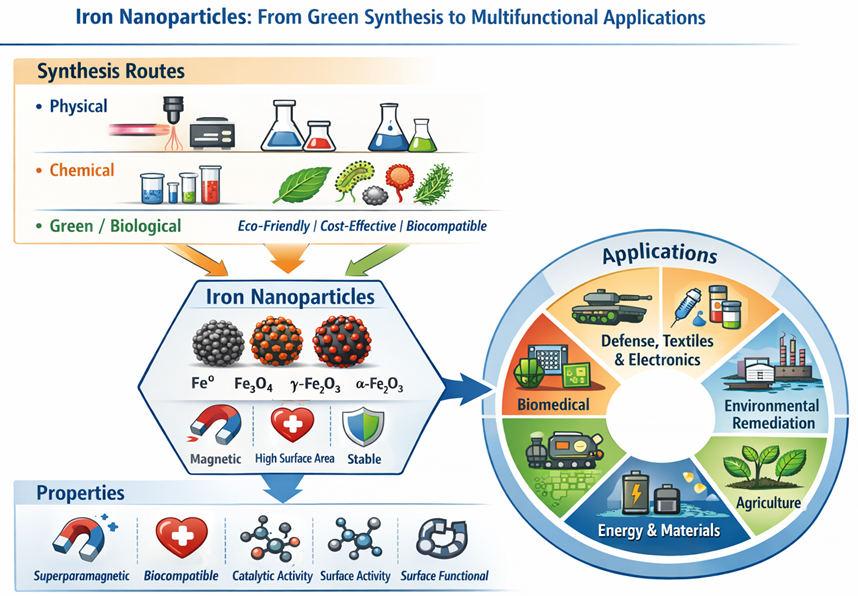
Iron nanoparticles (FeNPs), particularly iron oxide–based nanomaterials, have attracted significant scientific and industrial interest due to their unique physicochemical and magnetic properties, including superparamagnetism, high surface-to-volume ratio, tunable surface chemistry, and excellent biocompatibility. These characteristics enable their extensive application across diverse fields such as biomedicine, agriculture, environmental remediation, energy, electronics, and advanced materials. Conventional physical and chemical synthesis approaches provide controlled nanoparticle formation but are often associated with high energy consumption, toxic reagents, and environmental concerns. Consequently, green and biological synthesis strategies have emerged as sustainable alternatives, employing plants, bacteria, fungi, algae, and their metabolites as natural reducing and stabilizing agents.
This review comprehensively summarizes the fundamental properties of iron nanoparticles, outlines major physical, chemical, and biological synthesis routes, and highlights recent advances in green synthesis using plant extracts and microbial systems. Special emphasis is placed on the role of phytochemicals and biomolecules in nanoparticle reduction, stabilization, and functionalization. Furthermore, the review critically discusses the multifarious applications of iron nanoparticles, including targeted drug delivery, magnetic resonance imaging, hyperthermia therapy, biosensing, nanofertilizers, pollutant removal, wastewater treatment, energy conversion, defense technologies, construction materials, textiles, and electronics. Current challenges related to nanoparticle stability, aggregation, toxicity, and large-scale production are also briefly addressed. Overall, this review provides an integrated perspective on the synthesis–property–application relationship of iron nanoparticles and underscores their growing importance in sustainable and interdisciplinary technological development.
Graphical Abstract
Keywords: Iron nanoparticles, iron oxide nanoparticles, green synthesis, biological synthesis, plant-mediated synthesis, magnetic nanoparticles, biomedical applications, environmental remediation, agriculture, nanotechnology