Study on Reaction between Chloroformaldehyde and Acetamide
Abhijit Mallick *
Department of Chemistry, Academy of Technology, P.O. Aedconagar, Adisaptagram, Hooghly, 712121, W.B. India.
*Author to whom correspondence should be addressed.
Abstract
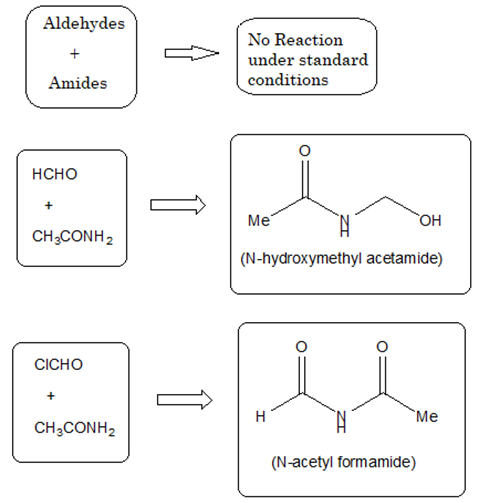
Aldehydes, in general, are known to exhibit limited reactivity toward amides, although some aldehydes, particularly formaldehyde, take part in addition reaction with amides. Formaldehyde readily undergoes addition reaction with acetamide, producing N-hydroxymethyl acetamide. In this transformation, the carbonyl group of formaldehyde is converted into an alcohol functional group, while the amide functionality remains unaltered, demonstrating a unique and specific interaction between these two simple compounds.
It is well established from previous literature that chloroform reacts with nitric acid to yield chloroformaldehyde, an aldehyde derivative characterized by the presence of an electron-withdrawing group. The presence of this group significantly enhances the electrophilicity of the carbonyl carbon, rendering the compound much more reactive than typical aldehydes.
The primary objective of the present study is to explore the chemical reaction between chloroformaldehyde and acetamide as well as to characterize the product of the reaction through experimental investigation and spectral analysis.
Detailed experimental study of the reaction reveals that group of chloroformaldehyde acts as leaving group, producing free chloride ion in the solution. Furthermore, the product mixture shows a negative response to the ceric ammonium nitrate test, suggesting the absence of any hydroxyl group () in the product molecule, thereby ruling out the possibility of an alcohol-containing product such as an N-hydroxymethyl derivative. In contrast, the product mixture gives a positive response to Tollen’s reagent, confirming the presence of an aldehydic group () group in the final product, indicating the possibility of substitution reaction.
The nuclear magnetic resonance (1HNMR) spectrum of the product sample distinctly shows proton signals corresponding to both an amide proton () and an aldehyde proton (). The coexistence of these signals in a single compound clearly indicates that substitution reaction occurs instead of condensation or addition reaction between amide and aldehyde group.
On the basis of these experimental findings and chemical analyses, a plausible reaction mechanism has been proposed to explain the chemical reaction between chloroformaldehyde and acetamide. The proposed mechanism involves a nucleophilic substitution reaction, where the group, attached to the carbonyl carbon of chloroformaldehyde, is replaced by the amide group of acetamide. This substitution leads to the formation of N-acetyl formamide as the principal reaction product, accompanied by the liberation of chloride ions. The overall mechanism shows the retention of both aldehyde and amide groups in the final product.
The present study thus provides new insights into the chemical behaviour of chloroformaldehyde with nitrogen-containing compounds and contributes to the broader understanding of aldehyde–amide reactivity.
Graphical Abstract
Keywords: Chloroformaldehyde, acetamide, N-acetyl formamide, chloride ion, Tollen’s reagent, ceric ammonium nitrate, substitution reaction